
Accounting + Finance
2026 Mid-Year Market Report
State of the Market
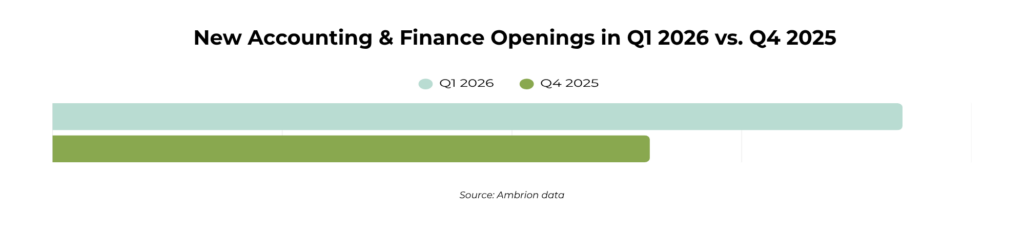
The Twin Cities market has shown remarkable resilience through the first half of 2026. It has maintained a healthy appetite for qualified accounting and finance talent against a backdrop of economic pressures. In fact, strong early-year hiring momentum drove a 42% increase in new accounting and finance openings in the Twin Cities from Q4 2025 to Q1 2026. Employers are more deliberate in their hiring decisions now, yes, but candidates who bring both technical expertise and adaptable skill sets will continue to find opportunities. Minnesota’s diverse economic base - spanning healthcare, financial services, technology, and manufacturing - has also been a stabilizing force. This breadth has shielded us from more volatile swings seen in other markets.
What we're observing is a recalibration, not a contraction. Said another way, our market has neither overheated nor cooled. Companies are sharpening their focus and making strategic hires to support growth initiatives and operational improvements.
Hiring Activity & Forecast
What This Forecast Means for Employers
1. Hire with urgency
This is a highly competitive market. Moving quickly on qualified talent is critical. If you delay decision-making, you risk losing candidates to competing offers.
2. Differentiate with compensation and flexibility
Market-aligned pay and thoughtful flexibility around work arrangements will play a significant role in attracting and securing passive talent.
3. Make your opportunity clear and compelling
Candidates are being more selective. Clear communication around culture, leadership, and growth opportunities will influence acceptance decisions.
AI’s Impact on Hiring and Workforce Reductions
Despite growing discussion around AI, it has not been the primary driver of workforce reductions in accounting and finance. Most reductions in late 2025 were tied to broader economic pressures and reduction efforts, not AI replacement.
Employers are not necessarily seeking accounting and finance professionals who are AI experts. Instead, they are prioritizing candidates who are comfortable with evolving technology, open to learning the tools, and able to adapt as workflow changes.
Familiarity with tools such as Microsoft Copilot, Power BI, automation platforms, and AI-assisted reporting capabilities is becoming increasingly valuable - particularly for professionals looking to stay competitive in a rapidly evolving environment.
AI is not eliminating accounting and finance jobs in the near term, but it is changing the skill sets and adaptability employers increasingly expect from top talent.
Work Location Trends
The return to cubicles and commutes has been gradual. What started as mostly remote in 2020-2022 shifted to light hybrid (1-2 days in-office) by 2023-2024. Since then, the majority of Twin Cities employers have settled on 3-4 days per week in the office.
In Q1 2026, about a quarter of the searches we worked on were fully on-site (5 days/week), and nearly 70% were hybrid. Out of those that were hybrid, over half require 3 days per week in the office. Employers offering 2-3 in-office days per week appear best positioned to attract and retain accounting and finance talent in this market.
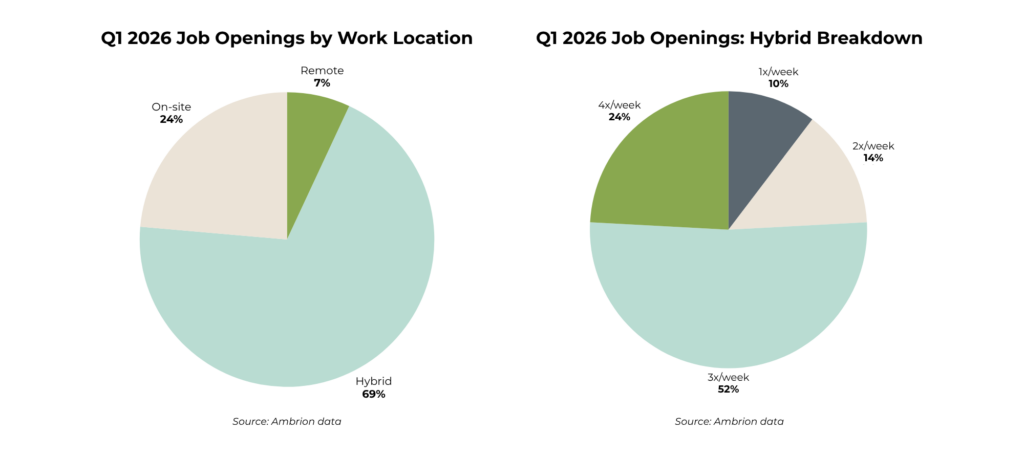
Fully remote opportunities have contracted from their pandemic-era peaks and are now typically limited to companies with multi-state teams. In Q1 of this year, only 7% of the searches we worked on were 100% remote. Accounting and finance professionals in the Twin Cities should expect at least some in-office time.
The Small and Mid-Size Company Advantage
As larger organizations continue increasing in-office expectations, small and mid-sized companies are gaining a competitive edge in attracting accounting and finance talent.
We’re seeing professionals leave large enterprises for opportunities that offer:
- Flexible hybrid schedules with fewer required in-office days
- Office locations closer to where employees live
- More agile, outcome-focused cultures
Flexibility and quality of life continue to influence candidate decisions – particularly among experienced, passive talent.
Emerging Demand Areas
Data Visualization and Analytics
More than a quarter of our searches last year required experience in data visualization and analytics. Companies are seeking professionals who can:
- Build dashboards and reports using Power BI, Tableau, or Excel
- Transform financial data into visual insights that drive decision-making
- Present complex information in clear, actionable formats for non-finance stakeholders
As organizations automate routine reporting, the ability to turn data into actionable insights has become a key differentiator.
M&A and Integration Support
Nearly half of the searches we worked on in 2025 involved M&A activity. Companies need professionals experienced in:
- Due diligence and financial analysis for acquisitions
- Acquisition integration and post-merger financial consolidation
- Cross-border transactions and complex deal structures
This expertise remains in high demand as dealmaking activity continues across healthcare, manufacturing, and technology sectors in the Twin Cities.
Finance Transformation
About a third of our searches last year required experience leading or supporting major transformation initiatives. Companies are looking for professionals who can:
- Lead ERP implementations and system migrations
- Redesign finance processes for efficiency and scalability
- Manage change across teams during technology transitions
As companies modernize their tech stacks, this skill set is increasingly valuable, particularly for talent who can bridge technical knowledge with change management.
FP&A and Strategic Finance
More than half of our searches this year have involved FP&A or strategic finance capabilities. Companies are seeking professionals who can:
- Build financial models and forecasts that support strategic decision-making
- Partner with business leaders to provide financial insights
- Drive budgeting and variance analysis that connects financial planning to business performance
This expertise has become critical as organizations prioritize data-driven decision-making and cross-functional collaboration.
Key Takeaways
The Twin Cities market is recalibrating, not contracting.
- Speed and clarity are now competitive advantages in hiring
- The strongest talent remains selective and largely passive
Hiring activity continues on both sides. What’s new in 2026 is how deliberate employers and talent have become. Those who recognize this shift and adjust accordingly will navigate this market most effectively.
This report reflects our observations from the Twin Cities accounting and finance market. If you’d like to discuss how these trends might impact your hiring strategy or career planning, we’re here to help.
Accounting + Finance
2026 Mid-Year Market Report
State of the Market
The Twin Cities market has shown remarkable resilience through the first half of 2026. It has maintained a healthy appetite for qualified accounting and finance talent against a backdrop of economic pressures.
In fact, strong early-year hiring momentum drove a 42% increase in new accounting and finance openings in the Twin Cities from Q4 2025 to Q1 2026.
Employers are more deliberate in their hiring decisions now, yes, but candidates who bring both technical expertise and adaptable skill sets will continue to find opportunities. Minnesota’s diverse economic base - spanning healthcare, financial services, technology, and manufacturing - has also been a stabilizing force. This breadth has shielded us from more volatile swings seen in other markets.
What we're observing is a recalibration, not a contraction. Said another way, our market has neither overheated nor cooled.
Companies are sharpening their focus and making strategic hires to support growth initiatives and operational improvements.
Hiring Activity & Forecast
What This Forecast Means for Employers
1. Hire with urgency
This is a highly competitive market. Moving quickly on qualified talent is critical. If you delay decision-making, you risk losing candidates to competing offers.
2. Differentiate with compensation and flexibility
Market-aligned pay and thoughtful flexibility around work arrangements will play a significant role in attracting and securing passive talent.
3. Make your opportunity clear and compelling
Candidates are being more selective. Clear communication around culture, leadership, and growth opportunities will influence acceptance decisions.
AI’s Impact on Hiring and Workforce Reductions
Despite growing discussion around AI, it has not been the primary driver of workforce reductions in accounting and finance. Most reductions in late 2025 were tied to broader economic pressures and reduction efforts, not AI replacement.
Employers are not necessarily seeking accounting and finance professionals who are AI experts. Instead, they are prioritizing candidates who are comfortable with evolving technology, open to learning the tools, and able to adapt as workflow changes.
Familiarity with tools such as Microsoft Copilot, Power BI, automation platforms, and AI-assisted reporting capabilities is becoming increasingly valuable - particularly for professionals looking to stay competitive in a rapidly evolving environment.
AI is not eliminating accounting and finance jobs in the near term, but it is changing the skill sets and adaptability employers increasingly expect from top talent.
Work Location Trends
The return to cubicles and commutes has been gradual. What started as mostly remote in 2020-2022 shifted to light hybrid (1-2 days in-office) by 2023-2024.
Since then, the majority of Twin Cities employers have settled on 3-4 days per week in the office.
In Q1 2026, about a quarter of the searches we worked on were fully on-site (5 days/week), and nearly 70% were hybrid. Out of those that were hybrid, over half require 3 days per week in the office.
Employers offering 2-3 in-office days per week appear best positioned to attract and retain accounting and finance talent in this market.
Fully remote opportunities have contracted from their pandemic-era peaks and are now typically limited to companies with multi-state teams. In Q1 of this year, only 7% of the searches we worked on were 100% remote. Accounting and finance professionals in the Twin Cities should expect at least some in-office time.
The Small and Mid-Size Company Advantage
As larger organizations continue increasing in-office expectations, small and mid-sized companies are gaining a competitive edge in attracting accounting and finance talent.
We’re seeing professionals leave large enterprises for opportunities that offer:
- Flexible hybrid schedules with fewer required in-office days
- Office locations closer to where employees live
- More agile, outcome-focused cultures
Flexibility and quality of life continue to influence candidate decisions – particularly among experienced, passive talent.
Emerging Demand Areas
Data Visualization and Analytics
More than a quarter of our searches last year required experience in data visualization and analytics. Companies are seeking professionals who can:
- Build dashboards and reports using Power BI, Tableau, or Excel
- Transform financial data into visual insights that drive decision-making
- Present complex information in clear, actionable formats for non-finance stakeholders
As organizations automate routine reporting, the ability to turn data into actionable insights has become a key differentiator.
M&A and Integration Support
Nearly half of the searches we worked on in 2025 involved M&A activity. Companies need professionals experienced in:
- Due diligence and financial analysis for acquisitions
- Acquisition integration and post-merger financial consolidation
- Cross-border transactions and complex deal structures
This expertise remains in high demand as dealmaking activity continues across healthcare, manufacturing, and technology sectors in the Twin Cities.
Finance Transformation
About a third of our searches last year required experience leading or supporting major transformation initiatives. Companies are looking for professionals who can:
- Lead ERP implementations and system migrations
- Redesign finance processes for efficiency and scalability
- Manage change across teams during technology transitions
As companies modernize their tech stacks, this skill set is increasingly valuable, particularly for talent who can bridge technical knowledge with change management.
FP&A and Strategic Finance
More than half of our searches this year have involved FP&A or strategic finance capabilities. Companies are seeking professionals who can:
- Build financial models and forecasts that support strategic decision-making
- Partner with business leaders to provide financial insights
- Drive budgeting and variance analysis that connects financial planning to business performance
This expertise has become critical as organizations prioritize data-driven decision-making and cross-functional collaboration.
Key Takeaways
The Twin Cities market is recalibrating, not contracting.
- Speed and clarity are now competitive advantages in hiring
- The strongest talent remains selective and largely passive
Hiring activity continues on both sides. What’s new in 2026 is how deliberate employers and talent have become. Those who recognize this shift and adjust accordingly will navigate this market most effectively.
This report reflects our observations from the Twin Cities accounting and finance market. If you’d like to discuss how these trends might impact your hiring strategy or career planning, we’re here to help.