

You need to hire, so you open a blank document, paste in an old job description you’ve used before, update the title, tweak a few bullet points, and then post it to your company’s career page. You get applicants, but none of them are a fit for what you’re looking for. Part of the problem is the job description. Getting qualified talent to apply starts with a job posting that describes it as an opportunity, not a function.
In this blog, we’re going to show you how to create high-quality job descriptions and common mistakes to avoid.
The 4 Most Common Mistakes in Job Descriptions

Before we get to the how, let’s talk about some common job description mistakes, so you can avoid them.
1. The Laundry List
Does the image below look familiar? If so, that’s because you’ve probably seen this type of job posting all over on LinkedIn, Indeed, company career pages, and even on relics from the past like Monster.
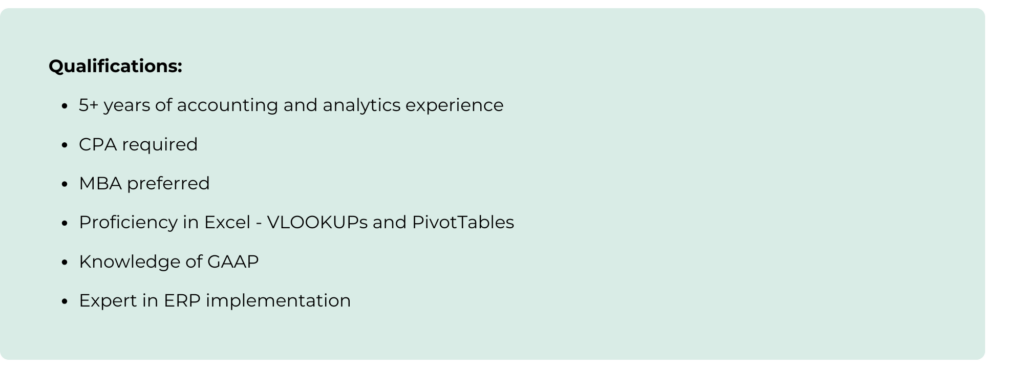
The problem with the laundry list is that it reads like a checklist rather than a conversation. And, it says nothing about what makes your role worth pursuing to a potential candidate.
2. The Culture Copy-Paste
A lot of job postings will say something along the lines of this to describe the company culture:

What does that even mean? It doesn’t. It’s just a whole bunch of corporate buzzwords. The best job descriptions describe a company’s culture in specific, concrete ways that give candidates a feel for what it’s really like to work there.
3. The Missing Day-in-the-Life
Let’s take a Senior Financial Analyst as an example. Most who are looking at job postings want to know: What does the day-to-day look like? Is it heavy in reporting? Will I get to influence decisions? Would I be walking into a well-oiled process, or would I get to build from the ground up? What do the opportunities for professional growth look like?
A job description that doesn’t answer these types of questions forces candidates to guess — and they’ll often guess wrong, or just move on to other job postings.
4. No Story About the Team, the Leader, or the Company
This is the biggest missed opportunity we see with job descriptions. Most accounting and finance professionals are looking for more than just a 9-5, get-in-get-out, pays the bills type of job. They want to work at a place where they feel connected to a purpose, like the people they work with, and are supported by their leader.
If your job description doesn’t give them a reason to believe in any of those things, you’re leaving your strongest selling points on the table.
How to Write a High-Quality Job Description
Start With the “Why Should I Care?” Paragraph
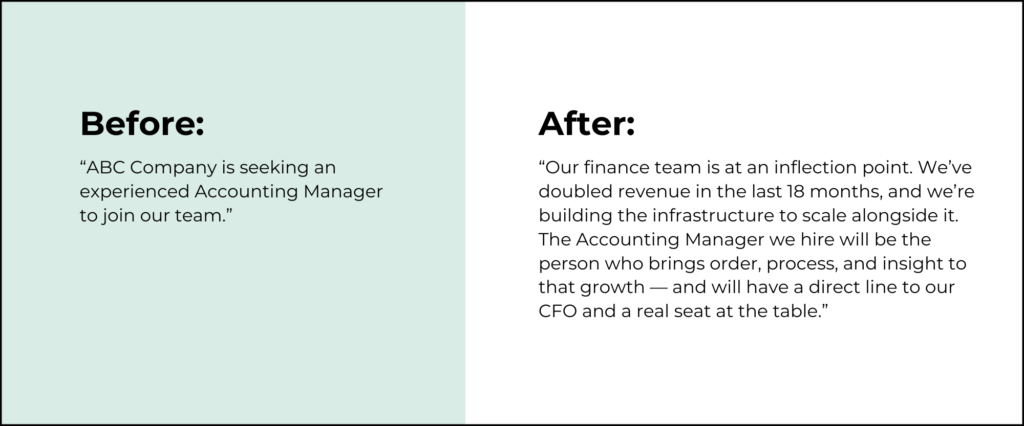
Before you list a single requirement, write 3-4 sentences that answer this question from the candidate’s perspective: Why is this role worth my time to read about?
Here is an example of what that looks like:
Describe the Job Duties in a Compelling Way
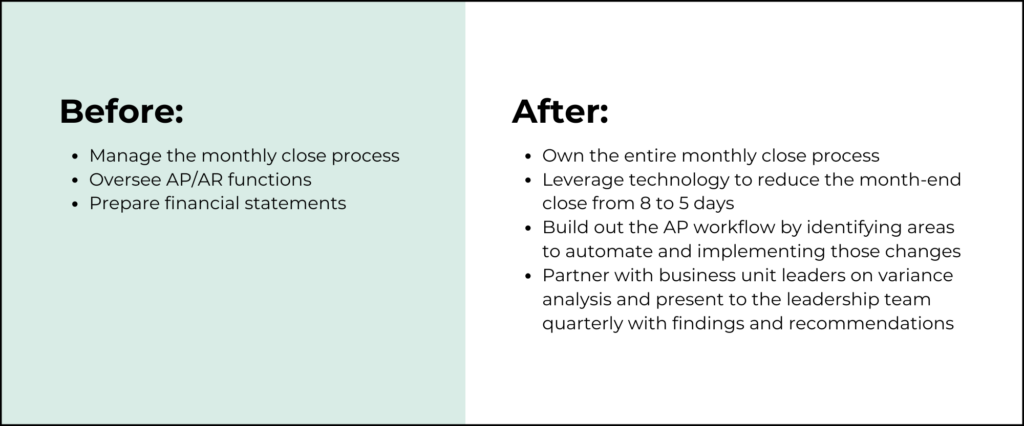
Use this section of your job posting to tell a vivid story about where the company is, what the challenges are, and what impact the person in this role will make. Another way to frame these bullet points is what will this role make, save, and achieve?
Here is an example of what that looks like:
Write About the Team and the Leader
Candidates evaluate the “about us” description just as much as the job duty bullet points. Add 1-3 sentences to the job description about who this role reports to, what the team looks like, and how they typically work together.
Here’s an example:

Be Honest About Requirements & Flexible Where You Can Be
One of the fastest ways to lose the interest of qualified talent is a requirements section that comes across like a child’s wishlist to Santa. Long and unrealistic.
Instead, decide which of the requirements are truly non-negotiable, and which are defaults you’ve always included in your job postings. It’s okay to ask for what you want, but be realistic about what you can receive.
Here is an example of how to do that:
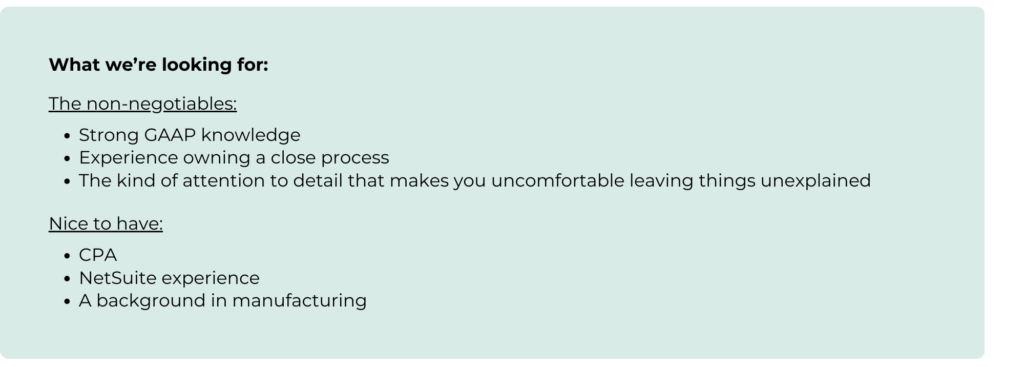
That framing invites strong candidates who might have self-selected out, and still sets clear expectations for what qualifications a candidate has to have to be successful in the role.
Using AI to Strengthen Your Job Description
AI tools, like Claude, can be helpful, but they shouldn’t be doing all the work. You (the human) still need to review, apply critical thinking skills, and make changes/edits.
If you just ask for “a job description for a Senior Accountant,” you’ll get exactly the kind of generic output this post is arguing against. Instead, use AI as an editor and thought partner.
Try prompts like these:



Your Job Description Checklist
Before you hit publish, run through these:
- Does the opening paragraph give a candidate a reason to keep reading?
- Does the responsibilities section describe work and impact, not just a function?
- Have I said something real and specific about the team and the hiring manager?
- Have I described the company in a way that’s distinct from other companies?
- Have I separated true requirements from nice-to-haves?
- Could someone read this and know, genuinely, if they’d thrive here?
If you can answer yes to all six, you’re ready to go!
Final Thoughts
The best accounting and finance professionals have options. Your job description is often the first and only chance to convince them that your role is where they want to be.
Make it count.