
Choosing a recruiting partner is one of the most overlooked hiring decisions a company makes. The right partner can shorten hiring timelines, improve candidate quality, and become a long-term advisor. The wrong one can cost months of lost productivity and another search.
This is a practical guide to finding the right recruiting partner for your specific hiring needs.
The Different Types of Recruiting Firms

Recruiting agencies generally fall into two primary categories: high-volume or high-touch. Choosing the right one comes down to your hiring goals, the role’s complexity, and the type of recruiting relationship you’re looking for.
High-Volume
These agencies operate on speed, scale, and wide reach. They leverage expansive candidate databases and broad job board distribution to quickly present a high volume of active job seekers across a range of skill sets.
Best for: Rapid scaling or generalist positions with a large, easily accessible talent pool.
High-Touch
These firms operate with a focus on depth over breadth. They limit the number of active searches their recruiters handle so they can conduct targeted, passive recruitment and serve as consultative talent advisors throughout the process. Sometimes, high-touch firms are referred to as “boutique.” But boutique does not necessarily mean limited capability; it means specialized expertise. Rather than recruiting across dozens of industries and functions, these firms focus deeply on a specific discipline or market. Their recruiters spend every day building relationships within the talent communities they serve.
Best for: Specialized roles where candidate quality and long-term retention outweigh speed.
Brand Recognition vs. Expertise
It’s natural for some businesses to gravitate towards the household names of recruiting firms. But strong brand recognition alone doesn’t automatically tell you whether a firm is the right fit for your search. Instead, when choosing a recruiting partner, evaluate whether they have the expertise, relationships, and market knowledge to align with your hiring needs.

For example, if you’re trying to buy a home in Minneapolis, you may think of the name of a national real estate agency first. But the local real estate expert who knows the neighborhood like the back of their hand might be better suited to help you find your new home.
Evaluating Industry and Role Specialization
When reviewing potential recruiting partners, “specialization” can refer to an industry domain (such as Healthcare or Manufacturing) or a functional discipline (such as Accounting and Finance or IT). The best partner is one with deep market expertise and established relationships. Specialized recruiters invest years cultivating networks within a specific discipline, which becomes their greatest competitive advantage when recruiting passive talent.
These 3 indicators can help you evaluate genuine depth:
Network Depth over Keyword Matching
True specialization means tapping into an established, warm network of passive talent rather than starting a cold search from scratch. Ask prospective partners about recent placements in your specific discipline and how they engage candidates who aren’t on job boards.
Market and Compensation Intelligence
Recruiting partners with true role or industry specialization understand real-time market dynamics. They can give you immediate, realistic guidance on compensation expectations, talent availability, and candidate motivators for your target profile.
Fluency in Technical Assessment
The recruiter representing you should be able to speak your ideal candidate’s language. They don’t need firsthand experience in the role, but they must understand the role’s core competencies and nuances well enough to pre-screen candidates effectively before sending them to you.
|
Evaluation Tip:
|
Assessing the Vetting Process and Candidate Experience
A quick way to test a potential recruiting partner’s quality is to dig into their screening workflow. Remember that external recruiters act as an extension of your employer brand. A forceful or disorganized agency can leave a negative impression on candidates that reflects directly back on your company.
When interviewing prospective agencies, ask direct operational questions:

Pay attention to the questions recruiters ask during the intake process. A strong recruiting partner should spend as much time understanding your business, culture, and hiring goals as they do sourcing candidates. The quality of their questions often determines the quality of the candidate they present.
If the process consists of taking a job description over email, running a basic LinkedIn keyword search, and forwarding unvetted profiles, they are acting as a resume clearinghouse rather than a strategic talent partner.
Data and Transparency
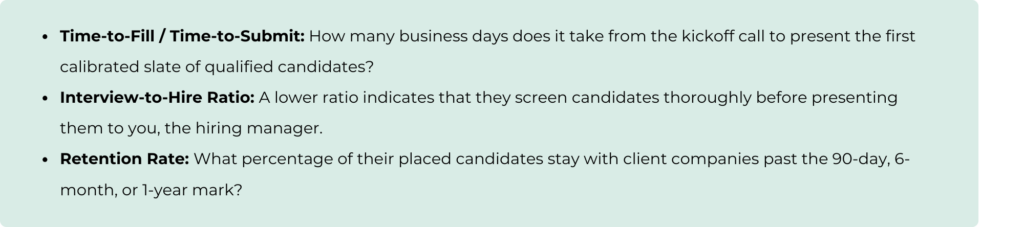
A strong recruitment partner operates as an advisor, not just a vendor. Pay attention to how transparent they are about their metrics and contractual terms.
Key metrics to inquire about:
Final Thoughts
Choosing a partner comes down to finding alignment across specialization and process. Take the time to vet agencies with the same rigor you’d apply to hiring a key executive.
The best recruiters will do more than fill your openings. They become long-term relationships built on trust and a shared commitment to building great teams for your organization.
FAQs
Will I work with one recruiter or will there be multiple that I am talking to/working with?
This varies by firm. Some agencies use a “pod” model where you interact with different account managers and recruiters. Other firms assign a single dedicated point of contact who manages your search from intake through placement and is backed by an internal sourcing team. Be sure to ask who will be directly accountable for executing your search.
What happens if the recruiter doesn’t find the right candidate?
Your recruiting partner should be consulting with you in weekly check-ins. Any hurdles they are facing in identifying qualified candidates should be made known to you.
Related Resources
- How to Attract and Hire Public Accounting
- How To Create High-Quality Accounting & Finance Job Descriptions
- How to Structure an Effective Interview