

Many large companies have well-defined org charts. When someone leaves, the decision is often straightforward: replace that role. For growing small and middle-market businesses, it’s rarely that straightforward.
Should your next hire be a Senior Accountant or an Accounting Manager?
Smart leaders are taking a step back to evaluate what their team needs next. The right hire isn’t necessarily the title of the person who just left; it’s the one who brings the specific ownership and scope required to drive your business forward.
Start with the Problem, Not the Title

Before posting a job description, ask yourself one foundational question: What problem are we trying to solve?
If your team simply needs more hands on deck to crunch numbers, build spreadsheets, and execute daily tasks, a Senior Accountant will give you the best ROI (return on investment). But if your department is struggling with process ownership, accountability, and execution, it might mean you need an Accounting Manager.
A common mistake small business owners make when hiring is assuming a manager must have direct reports. This is not always the case.
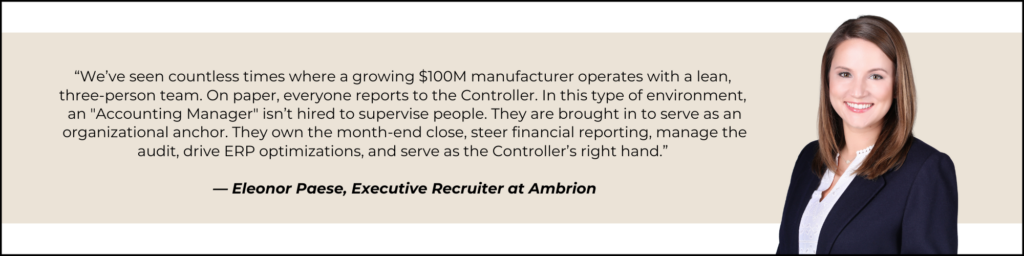
The distinction isn’t about seniority or headcount; it’s about the level of autonomy and ownership they bring to the table.
5 Questions to Help You Decide
To figure out which profile fits your current needs, ask yourself these five questions:
1. Are You Solving a Capacity Issue or an Ownership Issue?
A Senior Accountant expands your team’s capacity to execute. If your existing staff is simply drowning under the sheer volume of reconciliations, month-end close tasks, and financial reporting, you have a capacity issue. Another Senior Accountant is the answer.
However, if you need someone to independently own the close process, drive process improvements, lead the audit, strengthen controls, and become the Controller’s right hand, you’re solving an ownership issue. That’s where an Accounting Manager adds the most value.
2. Has Your Business Become More Complex?
Growth breeds complexity, and complexity demands coordination. You’ve likely outgrown a standard individual contributor role if your business has recently taken on:
- Mergers or acquisitions
- Multiple legal entities or subsidiaries
- An ERP implementation or major software overhaul
- Heavier regulatory or stakeholder reporting requirements
- Geographic expansion or multi-state payroll/sales tax
- Rapid headcount growth
When these milestones hit, you don’t just need someone to do the work; you need someone to own the process.
3. Who Is Steering the Ship Day-to-Day?
Many middle-market Controllers wear too many hats, and as a result, they often become an accidental bottleneck. If they are still reviewing journal entries and answering the frontline questions, they are working in the business rather than on the business.
This means they have little time to focus on high-impact areas like planning, cash flow, business partnering, or strategic initiatives. An Accounting Manager creates massive leverage by taking ownership of the day-to-day accounting function, allowing the Controller to operate at a more strategic level.
4. Are Your Senior Accountants Already Acting Like Managers?
Look closely at your current team. Do you have a high-performing Senior Accountant who has:
- Coordinated the close schedule?
- Reviewed peer work?
- Troubleshot technical issues?
- Identified process improvements?
If they are already doing the job of owning the function (unofficially), your business already requires an Accounting Manager. It’s time to formalize the role.
5. Where Will the Business Be in 2 to 3 Years?
Hiring for today’s needs alone is a recipe for constant turnover. Great hiring decisions anticipate tomorrow’s challenges. If your business plan points toward aggressive growth, geographical expansion, or an eventual exit, hiring someone with the capacity to own a larger piece of your accounting function can position your business for its next stage of growth.
The Investment for Competence: Salary Benchmarks
Choosing between a Senior Accountant and an Accounting Manager isn’t just a decision about responsibilities; it comes with an investment decision.
As an example, if the Controller is spending 15 hours each month coordinating the close, reviewing work, answering questions, and managing processes, the additional investment in an Accounting Manager may quickly pay for itself by allowing your finance leader to focus on forecasting, business partnering, and strategic initiatives.
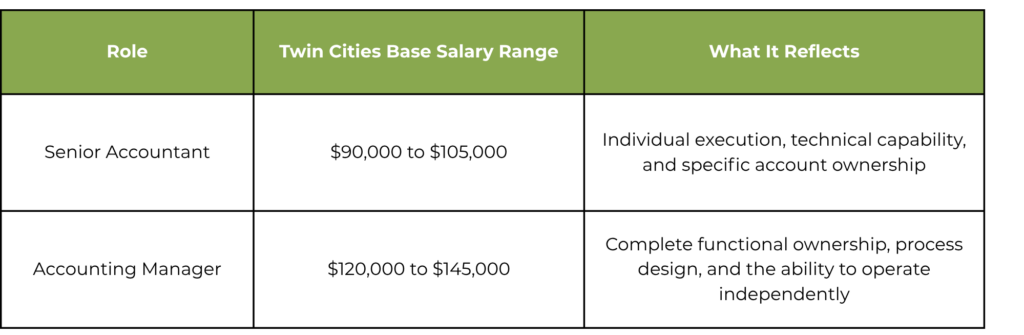
Note: Actual numbers can fluctuate based on factors such as company size, candidate qualifications, industry, market conditions, and the demand for a specific role.
The Bottom Line
For a growing business, deciding between a Senior Accountant and an Accounting Manager isn’t a simple HR transaction; it’s an organizational design decision. Stop counting the number of direct reports on your org chart. Instead, look at the weight of the responsibilities on your Controller’s shoulders.
The right hire isn’t defined by a job title; it’s defined by the scope of the problem you need them to solve.
Related Resources
- How to Attract and Hire Public Accounting
- How To Create High-Quality Accounting & Finance Job Descriptions
- Attractive Employee Perks and Benefits in 2026